Winter Rental Property Loans in Los Angeles: Seizing Opportunities in East LA

John Constantine • January 28, 2026

Rain keeps the amateurs away. While the average investor is hibernating, waiting for the spring bloom, the sharks are swimming. Winter in Los Angeles—specifically in the gritty, high-demand pockets of East LA like zip code 90022—is not a time to retreat. It is the season to acquire.


The market slows down. That is a fact. But price softening in Q4 and Q1 creates a buying window that vanishes by April. The problem? Most financing dries up just as the deals surface.


Traditional banks act like bears in winter. They sleep. Their underwriting processes grind to a halt due to holiday schedules and end-of-year book balancing. If you are relying on a conventional mortgage to snag a duplex near Whittier Boulevard, you will lose. You need speed. You need a rental property loan designed for agility, not bureaucracy.

Why East Los Angeles is the Winter Battleground

Forget the coastal glamour. Real cash flow happens east of the river. The 90022 area—covering parts of East Los Angeles and bordering Commerce/Montebello—is a dense, working-class stronghold. The rental demand here is bulletproof.


We aren't talking about luxury condos. We are talking about 1950s stucco homes on moderate lots, ripe for ADU (Accessory Dwelling Unit) additions. Tenants here stay for years. Vacancy rates remain historically low compared to the national average.


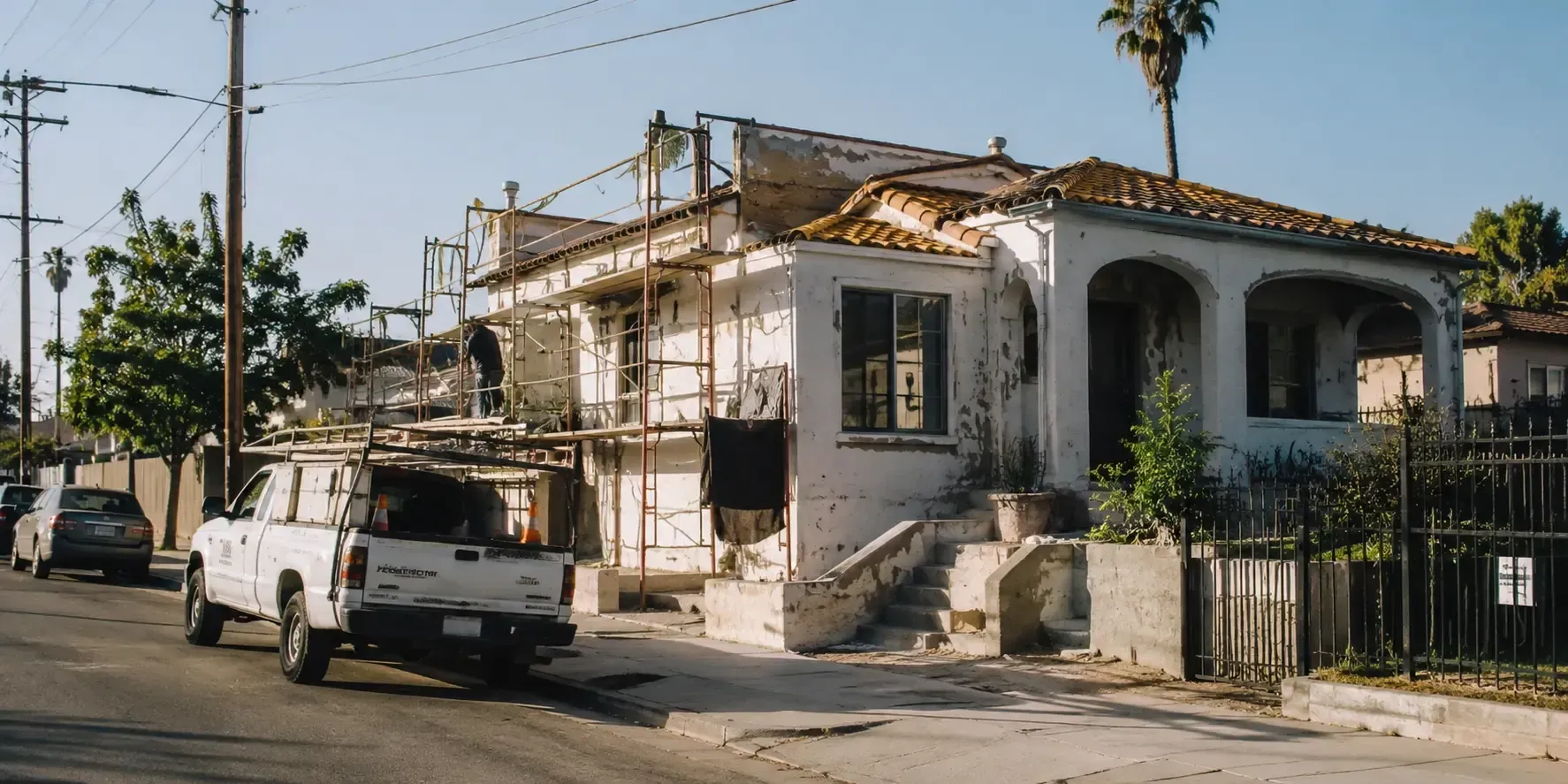
However, the housing stock is aging. Many properties hitting the market in December or January are "fixers" that traditional FHA lenders won't touch due to condition issues. Peeling paint? Bad roof? The bank says no. This is where the real estate investor with the right financing steps in to clean up.


The Financing Freeze: Why Banks Fail You in Q1

Walk into a Wells Fargo or Chase in late December. Ask for a loan on a rental property that needs $40k in rehab. Watch them laugh.


Conventional lenders operate on rigid debt-to-income (DTI) ratios. They scrutinize your tax returns from two years ago. They care about your W2. In the fast-moving world of distressed assets, this approach is obsolete. By the time a bank underwriter approves your file, another investor has already closed on the property with cash or private money.


According to recent housing data, inventory in Los Angeles tightens significantly in winter, meaning when a deal drops, the competition is fierce among those who actually have liquidity.
California Association of Realtors data consistently shows that time-on-market fluctuates seasonally, but the best assets never sit long.


Smart Financing: The DSCR Revolution

If you aren't using DSCR loans, you are working too hard.


DSCR stands for Debt Service Coverage Ratio. It is the holy grail for scaling a portfolio. Unlike a traditional mortgage, a DSCR rental property loan does not care about your personal income. It doesn't care if you are between jobs or if you write off all your expenses.


The math is simple:


Does the property generate enough rent to cover the mortgage, taxes, and insurance?

If the answer is yes, the loan gets approved.

For an investor eyeing a triplex near Belvedere Park, this is game-changing. You qualify based on the asset's performance, not your personal tax bracket. This allows you to scale. You can buy one, two, or ten properties without hitting the "four mortgage limit" that Fannie Mae often imposes.


Hard Money: The Bridge Over Troubled Water

Sometimes, the property is too ugly even for a DSCR loan. Maybe it lacks a kitchen. Maybe there is a hole in the roof. This is where Hard Money shines.


Hard money is short-term bridge financing. It gets you into the deal immediately—often in 7 to 10 days. You buy the distressed property, fund the renovation, stabilize the asset, and then refinance into a long-term rental property loan once the tenants move in. This is the BRRRR method (Buy, Rehab, Rent, Refinance, Repeat) in action.


Why Local Expertise Matters in 90022

Lending is local. A lender in New York does not understand the value of a property on Atlantic Blvd versus one tucked away near the 710 freeway noise. They don't understand the specific zoning nuances of Los Angeles County versus the City of Los Angeles, which creates massive differences in ADU permitting.


This is where
GRO Los Angeles Hard Money Real Estate dominates. We don't just lend; we analyze the dirt. We know that a property in East LA has inherent value because of the population density and proximity to the downtown job market.


While algorithms at big fintech companies are rejecting zip codes they deem "high risk," we see the equity. We understand that
LA County's aggressive ADU policies have turned standard single-family lots into multi-unit cash cows.


The "Winter" Strategy for 2024/2025

Don't wait for the sun to come out. By spring, interest rates may shift, and the casual buyers will return, bidding up prices. The contrarian investor buys when the sky is gray.


Here is your playbook:


  1. Identify distressed inventory in 90022 that has been sitting for 30+ days.
  2. Secure a proof of funds letter from a reputable local lender like GRO Los Angeles.
  3. Offer aggressively, knowing you can close in two weeks.
  4. Renovate during the rainy season (interior work first).
  5. Refinance into a 30-year fixed DSCR loan by spring, pulling your capital back out.


Real estate is not a passive sport. It requires aggression and the right financial partners. Stop asking banks for permission to invest. Start leveraging the asset's value.


Frequently Asked Questions

  • What is the minimum down payment for a rental property loan in Los Angeles?

    Most investment property loans, specifically DSCR programs, require a minimum down payment of 20% to 25%. While hard money loans for fix-and-flip projects can sometimes go as low as 10-15% down depending on experience, a stable long-term rental loan typically demands 20% equity to mitigate lender risk.


  • Can I get a rental property loan if the house is in bad condition?

    Traditional rental loans usually require the property to be habitable. However, you can use a "hard money" bridge loan to purchase and renovate the property first. Once the repairs are complete and the property is tenant-ready, you can refinance into a long-term DSCR rental loan.


  • How fast can GRO Los Angeles close a hard money loan?

    Speed is critical in the Los Angeles market. GRO Los Angeles Hard Money Real Estate can typically fund a deal in 7 to 10 business days, provided the title work is clear. This speed allows investors to compete with all-cash buyers in competitive zip codes like 90022.



By John Constantine April 7, 2026
Securing the right capital can dictate the long-term success of any property investment. For property owners and investors operating within East Los Angeles, California, evaluating existing debt structures is a core operational requirement. Refinance loans provide a mechanism to extract trapped equity, lower borrowing costs, or reposition a portfolio for future acquisitions. Los Angeles Hard Money specializes in providing rapid, asset-based capital solutions that bypass the heavy documentation requirements of traditional banking. Leveraging localized market knowledge allows investors to make swift financial maneuvers that align directly with their specific portfolio goals. Navigating Real Estate Refinance Loans in East Los Angeles The mechanics of refinancing involve replacing an existing debt obligation with a new one under different terms. In the dynamic East Los Angeles property market, investors frequently utilize refinance loans to execute two primary strategies: cash-out refinancing and rate-and-term refinancing.  A cash-out refinance allows property owners to tap into the appreciated value of their assets. By securing a loan amount greater than the existing mortgage, the borrower receives the difference in liquid capital. This liquidity becomes fuel for property improvements, stabilizing business operations, or funding down payments on new acquisitions within the region. Conversely, rate-and-term refinancing focuses strictly on altering the interest rate or the duration of the loan without extracting additional cash.
By John Constantine April 1, 2026
For homeowners in East Los Angeles, the transition from managing a primary residence to building an investment portfolio requires strategic financing. Traditional mortgages rely heavily on personal income, debt-to-income ratios, and extensive tax documentation. This creates a significant bottleneck for those looking to scale their property holdings quickly. Debt Service Coverage Ratio (DSCR) loans provide a highly practical alternative. By evaluating the cash flow potential of the investment property rather than the borrower's personal income, these loans allow ambitious homeowners to acquire new assets efficiently. Holding income-producing assets is a proven method for combating inflation and generating generational wealth. Partnering with GRO Los Angeles Hard Money Real Estate ensures you have the local expertise necessary to navigate this specialized financing landscape and secure the right capital for your acquisitions. 
By John Constantine March 24, 2026
East Los Angeles is sitting on a goldmine of underdeveloped dirt. Period. Look past the iconic arches of El Mercadito or the bustling stretch of Whittier Boulevard. What do you see? Pure opportunity. The real estate market here is shifting. Older properties with massive lots are begging for modernization. But cash is tight. Traditional banks move at a glacial pace. You need capital. Fast. That is exactly where specialized construction loans step in. 
By John Constantine March 21, 2026
East Los Angeles isn't for amateurs. The competition is brutal. Inventory is tight. Margins demand absolute precision. You either move fast, or you get left behind holding a pre-approval letter from a bank that doesn't understand the assignment. Real estate investing in this specific pocket of Southern California requires grit. It also requires the right capital. Investors targeting neighborhoods like Boyle Heights, Lincoln Heights, or El Sereno know exactly what they are up against. A dilapidated duplex hits the market. Within 48 hours, it has ten cash offers. How do you compete if you aren't sitting on a mountain of liquid cash? You deploy the exact same financial weapons the heavy hitters use. Fix and flip loans. 
By John Constantine March 18, 2026
East Los Angeles doesn't wait for slow banks. You spot a distressed multi-family property near City Terrace. The numbers make sense. The After Repair Value is solid. But traditional lenders want 45 days to close. That is a deal-killer. In the hyper-competitive local real estate market, speed isn't just an advantage. It is the entire game. Drive down Whittier Boulevard or through the winding streets of El Sereno. You will see it firsthand. Real estate investors are aggressively competing for limited inventory. According to recent data from the California Association of Realtors , Southern California housing inventory remains historically tight. When a good deal pops up, cash buyers and experienced flippers pounce. If your capital is tied up in another project, you miss out. Period. 
By John Constantine March 9, 2026
Your House Is a Bank Vault. Open It. Your house is sitting on a goldmine. Literally. Property values across East Los Angeles have skyrocketed over the last decade, transforming everyday homeowners into paper millionaires. But paper wealth is completely useless. It does not fund your next business venture. It will not cover emergency property renovations. It certainly does not buy your next investment property. To get actual cash, you have to extract that equity. Let me show you exactly how the professionals do it.  The real estate market in East LA is fiercely competitive. From the historic commercial stretches of Whittier Boulevard to the quiet residential pockets around Belvedere Park, long-term owners are holding massive amounts of equity. Amateurs stare at their estimated home values online and do nothing. Professionals pull that capital out and put it to work. You essentially have three primary paths to extract this cash. A standard bank refinance, a Home Equity Line of Credit (HELOC), or a hard money refinance. One of these options is vastly superior for serious investors.
By John Constantine March 8, 2026
The deal of the decade just hit the MLS in City Terrace. It’s a distressed Spanish Colonial with good bones, sitting on a hill with a view of downtown. You know the numbers work. You know the renovation costs. But while you’re scrambling to get a conventional bank manager on the phone, a cash buyer has already submitted an offer. Game over. This happens every day in the East Los Angeles real estate market. Speed isn't just a luxury here; it is the currency. If you are waiting 45 days for a traditional mortgage approval, you aren't investing; you're spectating. This is where bridge loans shatter the bottleneck. For investors targeting the vibrant, high-velocity neighborhoods from Boyle Heights to the edges of Montebello, bridge financing provides the liquidity needed to secure properties immediately. It’s not about cutting corners. It’s about cutting the red tape that strangles profitability.
By John Constantine February 21, 2026
You’re sitting in traffic on the I-5 or staring at a seven-figure price tag for a fixer-upper in East Los Angeles, and the math just doesn't add up. The cap rates are compressed. The margins are razor-thin. This is why the smart money isn't staying put. It’s moving. Specifically, it is flowing toward the Gulf Coast of Florida. Bradenton isn't just a retirement waiting room anymore. It is a high-velocity rental market fueled by migration, tourism, and a massive shift in how people view the Florida lifestyle. But finding the deal is only half the battle. Funding it is where the amateurs get separated from the pros. If you are still walking into a big box bank asking for a conventional mortgage with your tax returns in hand, you’ve already lost time. And in real estate, time kills deals. Here is the reality of securing rental property loans in Bradenton, FL, and why investors—even those watching from the West Coast—are turning to specialized financing to scale their portfolios. 
By John Constantine February 11, 2026
You can’t fake it in East Los Angeles. Drive down Whittier Boulevard or cruise past the bustle of the Golden Gate Theater, and you see a market that is raw, resilient, and rapidly appreciating. For developers, this isn't just another zip code. It’s a battlefield of opportunity. But finding the right financing here? That’s where most projects die on the vine. Traditional banks don’t get it. They see an older property near the 710 freeway and get nervous. They bury you in paperwork while your option period expires. You need speed. You need a partner who understands that real estate in East LA is about vision, not just checkboxes.  If you are looking to break ground in this historic pocket of Los Angeles County, you need construction financing that moves as fast as the market.
By John Constantine February 3, 2026
The bank just killed your deal. Again. You spent three weeks courting a loan officer, submitted two years of tax returns, and provided a stack of bank statements thick enough to stop a bullet. Then the email arrived. The property’s condition is "unsatisfactory." Or perhaps your debt-to-income ratio is off by a fraction of a percentage. Whatever the excuse, the result is the same: you lost the property to a cash buyer who closed in seven days. This is the reality of the modern real estate market. If you rely on traditional institutions, you are fighting with one hand tied behind your back.  To win, you have to stop thinking like a consumer and start thinking like a predator. Real estate investing is a game of speed, certainty, and specialized capital. Traditional lenders are built for stability, not profit. They want 30-year commitments from people with W-2 jobs and perfect credit. They don't understand the value of a fire-damaged triplex in Silver Lake or a mid-century fixer-upper in the Valley. That is where a hard money loan becomes your most potent weapon. It isn't just a loan; it is a strategic tool designed to bypass the bureaucratic red tape that strangles most investors.